Why Do We React Differently Reception Theory Explained
This means that a particular cell might be most sensitive to sweet followed by sour salty and bitter while another has its own ranking. This may be due to the fact that in many ways groups protect us.

The Reception Analysis Model Of Audience Effects Revisesociology
The cortex is the outermost shell of the brain that takes care of complex thinking abilities.

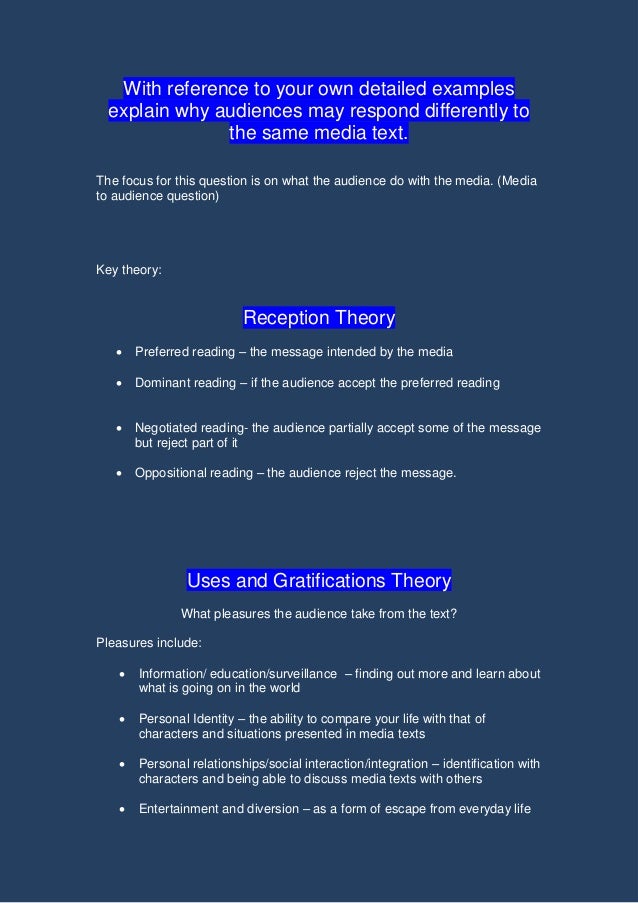
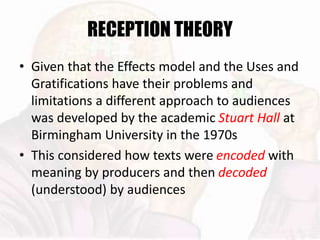
. Abuse but has played sports however might see this stimulus as a signal for a high five. The cultural theorist Stuart Hall explored how people make sense of media texts and claimed audiences were active not passive. It also helps us understand the relationship between the producer and audience of a text and how producers attempt to influence audiences to read their material in a particular way.
These readings can be influenced by many factors such as age gender and cultural understanding. Learning does not happen in the same way or at the same time for all students. Each cell has a specific palette of tastes with fixed rankings.
They only differ by having varying levels of sensitivity to the different basic tastes. However different audience members will decode the media in different ways and possibly not in the way the producer originally intended. Reception theory is far more complex in understanding as each mind perceives in its own way.
To generalize to a common example. When were in a group we have a strong tendency to conform to the norms of that group. Proprioception is the ability to know where and how your body is oriented in your surroundings.
It might turn out okay but often a reaction is something you regret later. There is also an association between musical creativity and psychopathology. Nonetheless we do know that there are many different variables that have been linked to a womans trauma response.
According to this theory Strength Immediacy and Number are three factors that impact a persons behaviour in social. Transduction represents the first step toward perception and is a translation process where different types of cells react to stimuli creating a signal processed by the central nervous system resulting in what we experience as a sensations. These are general statements and of course each woman will react uniquely to trauma.
This paper provides a brief review. Learning is the change in knowledge behavior or understanding that occurs when people make connections between new information and their existing knowledge. A reaction is survival-oriented and on some level a defense mechanism.
About half of the sensory cells react to several of the five basic tastes. The brain consists of many different structures and the cortex encases all of them. Psychologist Bibb Latané developed this theory in 1981 when he was at Ohio University.
The producer encodes messages and values into their media which are then decoded by the audience. Model Answer Audiences may respond to the same text differently by having different readings of the same text. A response on the other hand usually comes more.
Why do we study media audiences. The study of these perceptual processes shows that their functioning is affected by three classes of variables the objects or events. The content producer cannot takejudge for every single individual perspective.
It occurs continuously but you do not spend a great deal of time thinking about the actual process that occurs when you perceive the many stimuli that surround you at any given moment. TABLE OF CONTENTS 1 RECEPTION THEORY 11 Reception theory. Historical context and basic assumptions 12 Protention and Retention 13 Halls theory of prefered reading 2 MEDIA AND PSYCHOANALYSIS.
The extent to which patients perceive patient education as having cultural relevance for them can have a profound effect on their reception to information provided and their willingness to use it. One of my other favourite explanations of why people behave differently in different situations is based on the Social Impact Theory. Reception theory as developed by Stuart Hall asserts that media texts are encoded and decoded.
Explain factors that influence selection the first stage of the perception process. Reception analysis theory therefore suggests that audiences are not passive impressionable and homogeneous. All perception involves signals in the nervous system which in turn result from physical or chemical stimulation of the sense organs.
The perceptual process is a sequence of steps that begins with the environment and leads to our perception of a stimulus and action in response to the stimulus. Sensations allow organisms to sense a face and smell smoke when there is a fire. It attracts more than one type of reading or interpretation.
Through music we can learn much about our human origins and the human brain. It explains why we are more likely to selectively attend to some stimuli and not others. For example memory language spatial awareness and even personality traits.
Two peoplea so-called conservative and liberal pair will look at the same data and give different interpretations based on their desired outcomes. Social psychology helps explain the interesting ways we behave when were in a group. Various theories attempt to describe the factors that enable the learning process.
They act in a variety of subcultural ways and for this reason media content is polysemic ie. Other factors also contribute to an increased risk of developing a trauma response. Different individuals react differently to the same stimuli.
All cultures have systems of health beliefs to explain what causes illness how it can be cured or treated and who should be involved in the process. Freud and Lacans contributions to the psychoanalysis of film and television texts 21 Introduction 22 Psychoanalysis and its relevance to the analysis of film and. Perception is not reality but admittedly perception can become a persons reality there is a difference because perception has a potent influence on how we look at reality.
Why Do People Act Differently in Groups Than They Do Alone. Music is a potential method of therapy and a means of accessing and stimulating specific cerebral circuits. It is not the passive receipt of these signals but is shaped by learning memory expectation and attention.
The inner regions of the brain control the most primitive aspects of human nature such. When you have a proprioception impairment you may be clumsy have difficulty walking or may fall. A single person can have a mixed reaction of being a dominant oppositional and negotiated reader when they are going through the process of receiving the message.
Audience study helps to explain how important issues are seen by different people according to their gender age or social group.
Why Audiences May Respond Differently To The Same Media Text For As M
Exam Lessons 3 Audiences Section A A2 Media Exam
Stuart Hall Reception Theory Explained Youtube
No comments for "Why Do We React Differently Reception Theory Explained"
Post a Comment